
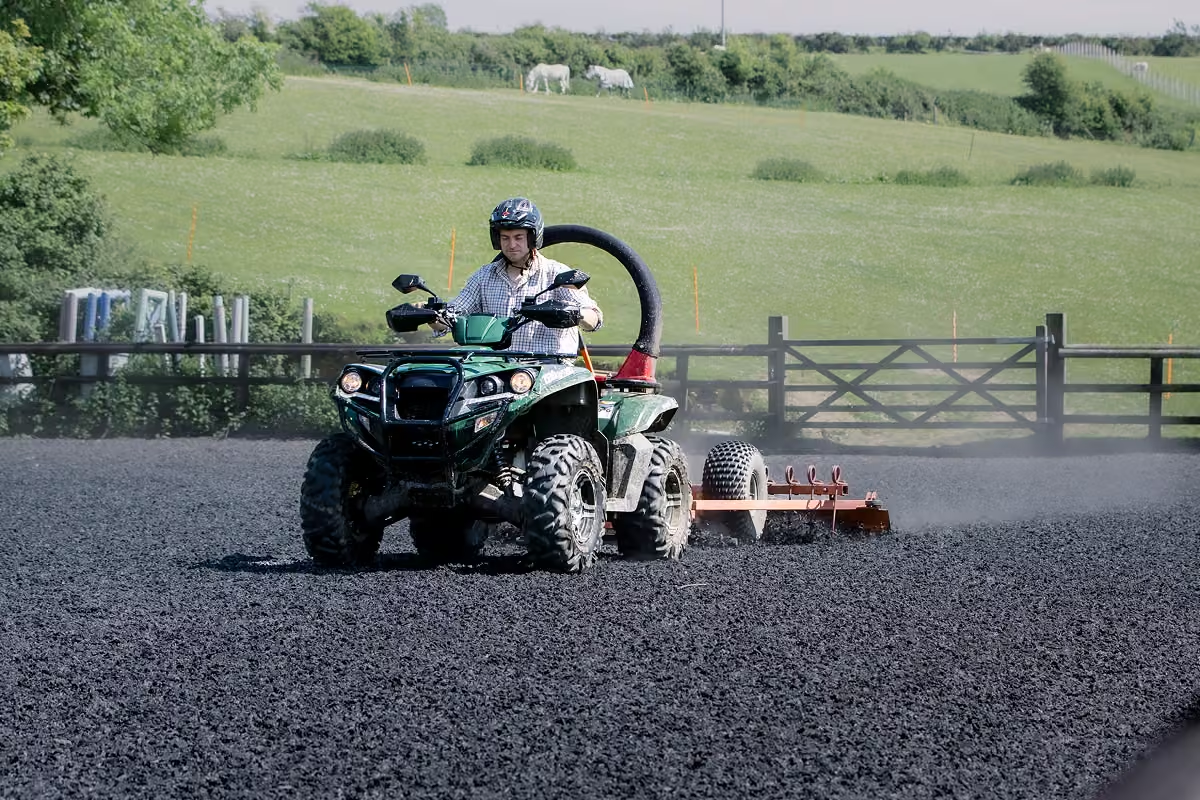
A working farm doesn’t ask much of a quad bike on any single trip. It asks for the same short, loaded, muddy run four or five times a day, in every kind of weather, for years.
Petrol quads have done that job on British farms for decades. To replace one, an electric quad has to match it on the work, last the day, fit the routine, keep running, and cost less over its life. Here’s how the VQ measures up on each.
Key specifications at a glance
- Torque: up to 140 Nm, configurable
- Towing capacity: 900 kg
- Range: up to 50 miles per charge (typical)
- Charging: 2.5 hours on a 13-amp plug, or around 30 minutes to 80% with an optional fast charger
- Battery Drivetrain: direct drive with no CVT, switchable 2WD/4WD, locking front differential
Can it do the same work as a petrol quad?
Yes, and the clearest evidence comes from a side-by-side test. Volt Quads took the VQ up a 20 km alpine trail in Austria alongside a petrol quad, on a 34°C day, to see how it coped in the toughest conditions the team could find. It kept pace the whole way, and came back down to the valley with a third of its charge still left.
That’s the same capability that matters in a rutted gateway, or on a wet bank with a trailer behind. The VQ delivers consistent torque on hills and under load, and it’s rated to tow up to 900 kg with a braked trailer. When the ground turns soft, the rider can switch into four-wheel drive and lock the front differential.
Because speed and torque can be configured, the bike can also be set up differently for different riders. A newer rider can have a gentler profile, while someone hauling a trailer keeps full power.
Will it last a full working day?
For typical farm use, yes. The VQ’s typical range is 50 miles per charge. Charles Anderson, Volt Quads’ chairman, covers about 2,000 miles a year on his farm.
Like a fuel tank, the battery empties faster when it’s working harder. Terrain, load and riding style all affect how far a charge goes.
Will charging get in the way of the work?
Not if the bike charges while it would be parked anyway. The VQ has its own on-board charger, so it plugs into a standard 13-amp socket and charges in 2.5 hours. A lunch break or an overnight charge covers that easily.
On longer days, the battery doesn’t have to hold the bike up either. The VQ’s 48V battery is designed to be swapped on site by the operator, without specialist tools or a technician. That means a farm can keep a charged spare in the yard or take one out with them, swap it in and carry on working.
Will the farm have to change how it works?
Very little, and most of what does change is for the better. There’s no new infrastructure to install, and no training programme to complete before the bike goes to work.
What riders tend to notice is what’s missing. There’s no engine noise, no fumes and no fuel to store, and the quiet means the bike is far less likely to unsettle livestock.
Will it need more looking after than a petrol quad?
Less. The VQ is direct drive, with no CVT, and has far fewer moving parts than a petrol quad, so there’s less for British terrain to damage or wear down. It needs one annual service by a VQ-approved technician.
The VQ itself was designed by Fred Chugg, who has worked with quad bikes for decades on his 15th-century farm on Exmoor. It’s manufactured in Telford and tested in North Devon. If anything does go wrong, support comes directly from the team who built it, and the battery is covered by a three-year warranty, with two years on the rest of the bike.
Will it cost more than a petrol quad?
To buy, yes. To own, no. At £15,750 ex VAT, the VQ costs more upfront than a comparable petrol quad, but over five years it works out between about £3,350 and £3,550 cheaper, even against an efficient petrol quad.
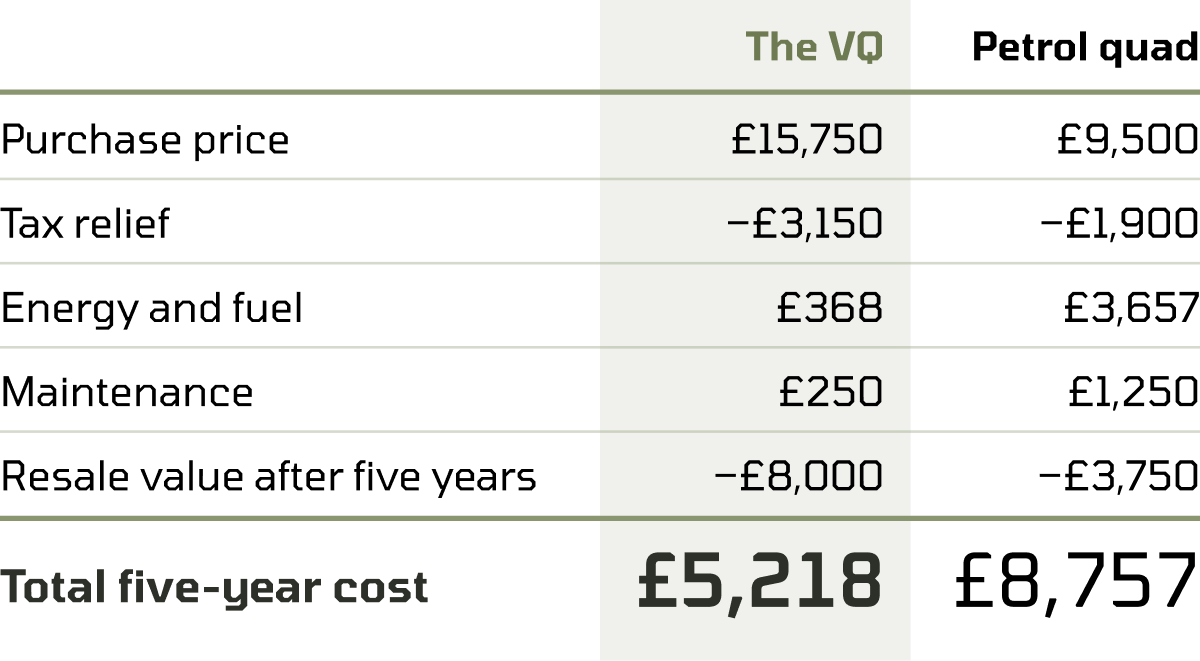
Most of the difference comes from fuel. The VQ uses around 0.10-0.15 kWh a mile, so at 26.32p per kWh it costs roughly 2.6-3.9p a mile to run. An efficient petrol quad doing 30 mpg costs about 26p a mile at 172.4p a litre. A more typical petrol quad, doing around 22.5 mpg, costs nearer 35p a mile. That’s £4,877 in fuel over five years, which would put the VQ’s saving between about £4,550 and £4,750.
The comparison assumes 2,800 miles a year, or 14,000 over five years, and a 100% capital allowance at a 20% tax rate. Servicing adds another £1,000 in the VQ’s favour.
So, can it replace a petrol quad?
Yes. It does the same work, fits the same routine, and costs less over five years.
Book a demo
The best way to judge any quad bike is to see it working. At a demo, you can watch the VQ tackle steep, rough ground, ride it yourself, and talk to the team who built it.


